For brokers, prop firms and funds
White label trading platform
Building a trading front end takes a team and eighteen months. Licensing one takes a scoping call. Pulsar ships under your brand, on your data source, routing to your venue.
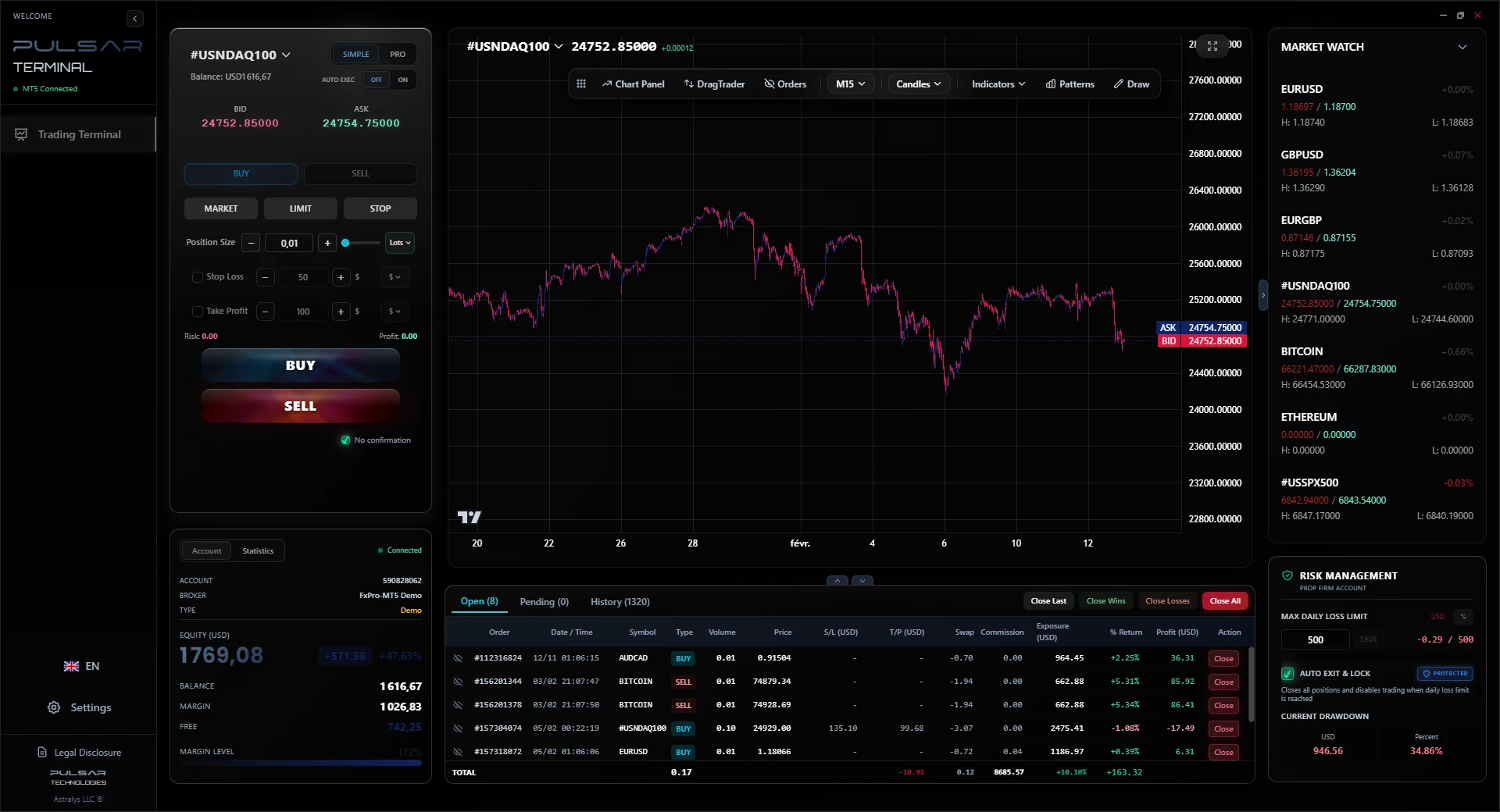
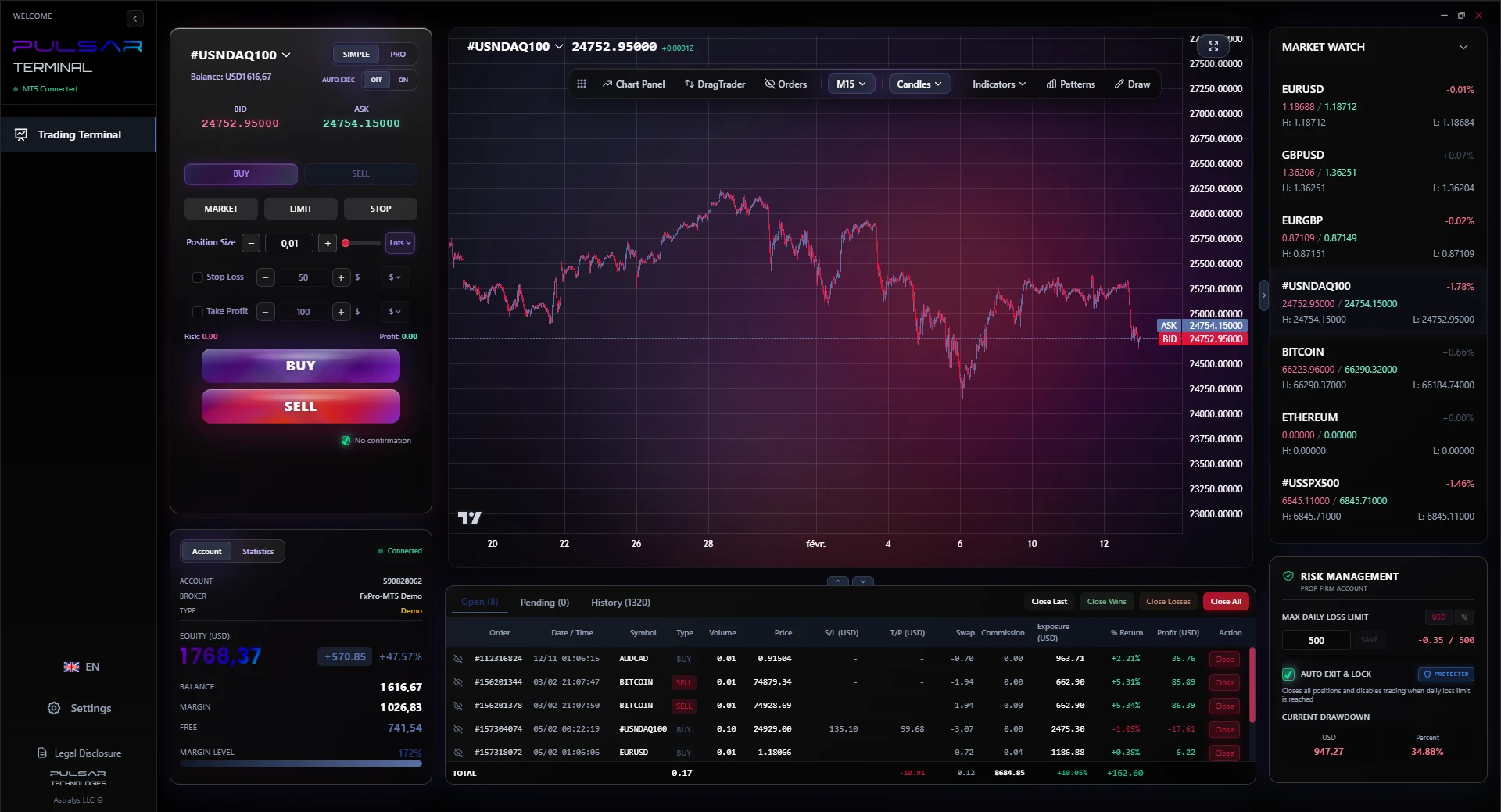
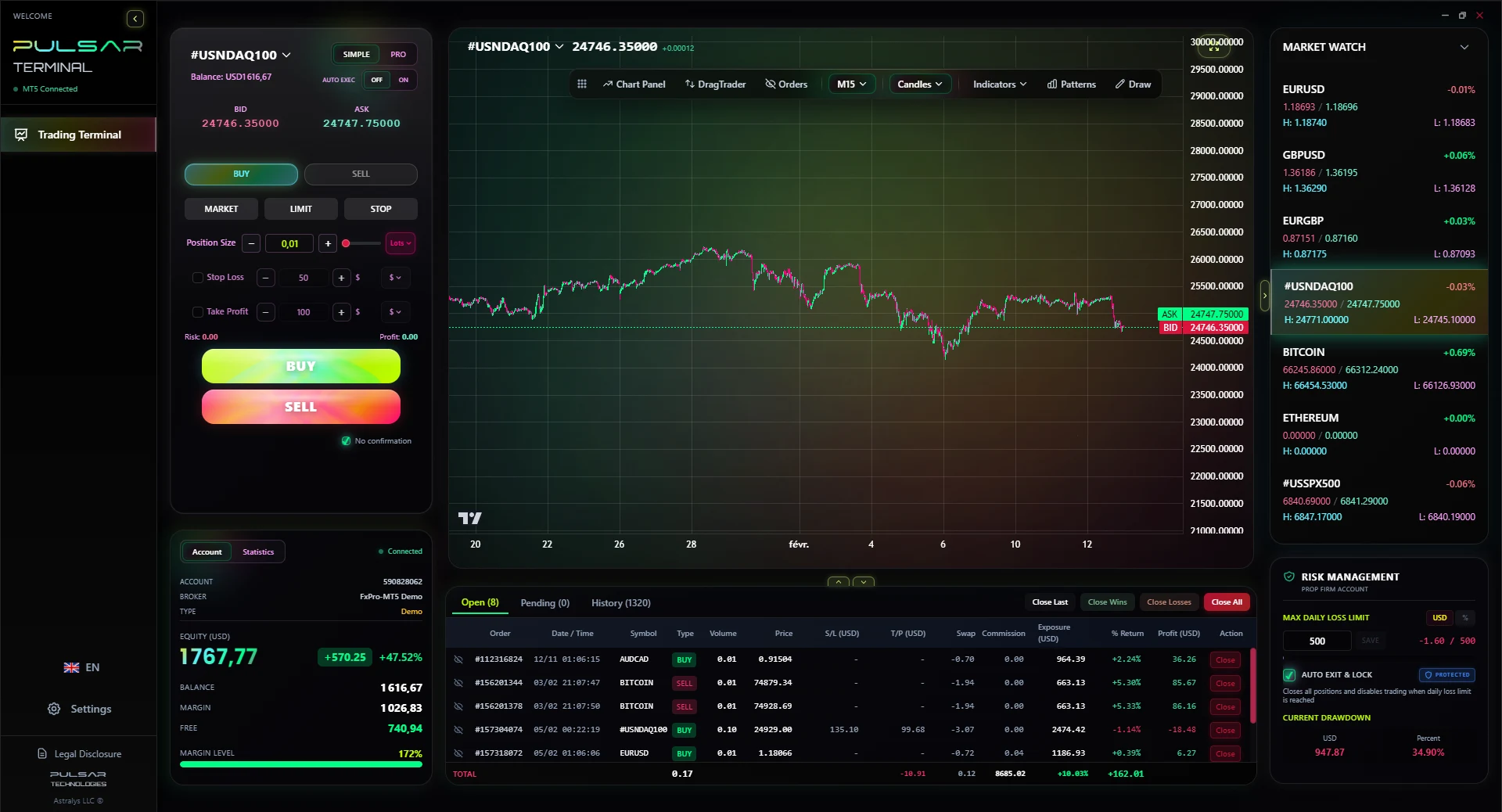
What carries your brand
A white label is not a logo swap. These are the surfaces that change.
Your name on the product
Application name, window title, installer and icon. The terminal ships as yours, not as a rebadged third party tool.
Your palette
The 7 shipped themes are a starting point. Custom themes are built to your brand colours as part of a white label engagement.
Your logo and assets
Splash screen, header mark and application icon replaced with your own artwork.
Your feature set
Modules can be enabled or hidden per deployment, so a simulation desk and a live desk do not have to see the same interface.
Connectivity, and who each option suits
The terminal is independent of where prices come from and where orders go. Pick per deployment.
Simulation
Runs on a proprietary feed with no live venue behind it.
Evaluation programs, training desks, product demos.
DXFeed
Institutional market data across equities, futures and FX.
Firms that need consolidated data independent of a broker.
Rithmic
Low latency futures data and order routing.
Futures desks and futures-based funded programs.
Broker API
Connects to your existing broker or venue through its own API.
Brokers putting their own front end in front of their book.
FIX protocol
Order routing and clearing over standard FIX sessions.
Institutional flow and prime brokerage relationships.
Proprietary feed
Your own pricing, delivered into the terminal.
Firms running an internal book or a synthetic product.
Signature
Built for funded account programs
An evaluation program does not need real liquidity. It needs realistic prices, reliable execution simulation, and rules enforced per account. Running the terminal in simulation mode removes the venue from the equation entirely, which changes both the cost structure and the regulatory surface of the product.
The Risk Management Engine enforces the constraints your program is built on, at the terminal, per account:
- Daily loss limit per account, enforced by closing open positions and blocking further orders
- Maximum drawdown tracking against a fixed or trailing floor
- Risk-based position sizing, so exposure is expressed as a share of account equity
- Multi-level exits with automatic partial closes at each take profit level
- Trailing stop and automatic breakeven, configured per account or per deployment
Enforcement runs in the terminal. It reduces the number of breaches that reach your books, it does not replace the server-side controls a program operator is responsible for.
How an engagement works
Four steps. Timelines depend on your connectivity, so we scope them on the first call rather than publishing a number we cannot hold.
01
Scoping call
We map your venue, your data source, the account model you run, and which modules your traders need.
02
Connectivity setup
The terminal is pointed at your feed and your execution path, whether that is simulated, an API, or FIX.
03
Branding and themes
Name, icon, installer and a custom theme built to your palette.
04
Rollout
Installers are handed to you for distribution to your traders, with the configuration baked in.
What it costs
The standard tiers are published: simulation at 14 USD per month, broker connectivity at 89 USD per month, and FIX protocol at 350 USD per month. White label sits outside that grid because the work depends on your connectivity, your branding scope and your seat count, so it is quoted per project.
Tell us what you are building
The first call is a scoping conversation, not a sales pitch. Bring your venue, your account model and your branding requirements, and we will tell you plainly whether this is a fit.
Start the conversation